A Guide for Procurement, Human Resources, and IT Teams
Smart Time and Attendance Solutions for Businesses and Organizations with IT Knowledge
From choosing a verification method to configuring shifts, reports, and integration: practical criteria to help you request a solution suited to your site and workforce.
Contact: 0541882204
Who Is This Guide For?
Business owners and operations, HR, procurement, and IT managers who want to organize working hours and request a clear technical proposal. Specifications and integration methods vary by device, software, and license. Requirements should therefore be confirmed in the written quotation after discussing the organization’s needs.
1. From Fingerprint Registration to Reliable Attendance Management
As an organization grows, attendance monitoring changes from a simple daily task into a series of questions: Who attended the branch? Who arrived late for a shift? Does an incomplete record indicate actual absence or a device problem? This is where time and attendance system installation in Riyadh becomes valuable as a complete administrative and technical project connecting the registration point with software, reports, and responsibilities. The aim is to provide clear information for HR review, give managers a practical picture of work attendance, and reduce time spent collecting files and matching names across departments and branches. Time and attendance devices form part of this assessment as the initial data collection point.
Businesses look for an employee fingerprint attendance system because they want to move from guesswork to verifiable records. However, buying a modern reader alone is not enough. The verification method, connection design, schedule configuration, and administrator training all affect the result. Time and attendance system installation in Riyadh therefore begins with understanding employee numbers, work activities, attendance locations, and shift arrangements before selecting a suitable solution. This guide provides practical criteria for requesting a quotation and comparing proposals, beyond general promises that do not explain what your organization will actually receive.
2. What Does IT Knowledge Establishment Offer Businesses in Riyadh?
IT Knowledge Establishment presents time and attendance and access control services in Riyadh on its website, including verification technologies, schedule configuration, and permission management. Businesses can begin discussing time and attendance system installation in Riyadh by sending a project description by phone on 0541882204 or through WhatsApp, specifying the number of users, branches, and doors to be managed. This information helps create a specific request rather than simply asking for a device price, and allows discussion of whether the organization needs a standalone device or a system connected to centralized management software with operation distributed across sites. This is one of the criteria for assessing business time and attendance systems before purchasing.
When asking about time and attendance software, request a written statement identifying the model, software, license, configuration services, training, and support. The features discussed in this guide are selection criteria rather than guaranteed specifications of every device offered by the establishment. The quotation for time and attendance system installation in Riyadh should clearly define what the project includes and what requires an additional agreement, such as software integration, a cloud subscription, or network cabling. This gives business owners and procurement managers a clear basis for comparison and helps the operations team understand its responsibilities before implementation begins.
3. How Does a Time & Attendance System Work?
The process starts by adding the employee to the database, assigning a consistent employee ID, and enrolling an approved verification method. When the employee checks in, the device creates an event containing the user identity, date, time, and registration point. The software then receives the record and compares it with the employee’s assigned schedule. Time and attendance system installation in Riyadh must therefore account for device and software compatibility. A Raw Log records the registration event, while an Attendance Report adds an interpretation based on the shifts, leave, and exceptions previously approved by management. If payroll integration is required, it should be recorded within the project scope.
Time and attendance devices differ in how they transfer events. They may send data over a local network, synchronize with a central server, or use manual exports in some solutions. What matters is knowing when the data appears, who reviews incomplete records, and how the process handles an employee who clocks in without clocking out. Good time and attendance system installation in Riyadh includes testing a complete cycle from registration to the final report, rather than merely hearing a success message from the device. A successful reading alone does not prove that time calculations are correct or that the management software contains complete data.

4. Fingerprint Verification: When Is It Suitable?
Fingerprint verification confirms an employee’s identity by comparing enrolled biometric characteristics and suits many office environments where readers can be used easily. Before choosing fingerprint-based time and attendance system installation in Riyadh, request a trial with a representative sample of actual employees, as finger condition, work activities, and sensor cleanliness can affect usability. An approved alternative is important when a fingerprint cannot be read, with controls preventing that alternative from becoming a route to uncontrolled registration or undocumented manual processing. An employee fingerprint attendance system needs configuration that suits its users and daily working practices.
Do not compare business time and attendance systems solely by device appearance or screen size. Ask about fingerprint template capacity, the number of templates supported per user, backup finger enrollment, and the ability to update employee information when necessary. During time and attendance system installation in Riyadh, test peak-time use and observe repeated attempts and queue length. If employees wear gloves or perform work that affects their fingers, discuss another verification method before purchasing. A solution suitable for an office may require adjustment when used in a factory or workshop.
5. Face Recognition: A Choice Guided by Testing
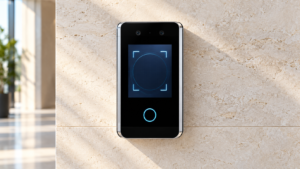
Face recognition enables attendance registration without touching the reader on devices supporting this function and may suit entrances requiring orderly movement. However, face-based time and attendance system installation in Riyadh requires testing lighting, mounting height, approach angle, and operating distance according to the model’s manual. An “AI” label alone is not enough. What matters is verification performance at the actual site, ease of employee enrollment, settings appropriate to working conditions, and a clear explanation of the data retained by the device and software. Time and attendance software remains central to the decision because it turns events into reports.
When comparing attendance-to-payroll integration options, specifically ask about Liveness Detection if required and how resistance to impersonation is tested within the product’s capabilities. No general result applies to every model or condition, so avoid assuming that every facial recognition device offers the same protection level. During time and attendance system installation in Riyadh, request trials with users of different heights and natural changes in appearance, then document cases requiring an alternative. This supports a decision based on observable performance rather than a brief marketing description.
6. RFID Smart Cards and Multiple Verification Methods
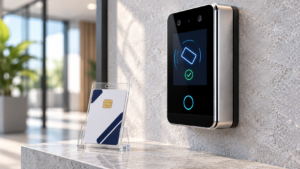
Cards present an electronic identifier to the reader and can be practical when an organization needs a method that is easy to issue and revoke. However, presenting a card alone does not prove that its holder is the intended employee. Card-based time and attendance system installation in Riyadh therefore needs a clear policy for safeguarding cards, reporting losses, and disabling them. This method may suit some offices, visitors, or cases where biometric verification is unavailable, provided permanent employee permissions are separated from temporary passes and cards are not shared between several people. Time and attendance devices form part of this assessment as the initial data collection point.
An employee fingerprint attendance system may support several methods, such as face, fingerprint, card, and PIN, but supporting multiple methods does not necessarily mean they must be used together. Ask whether the device allows the choice of one method or can require Multi-factor Authentication where needed. Time and attendance system installation in Riyadh requires this policy to be defined before enrolling users, with accepted alternatives and authorizing roles documented. Also review card type and compatibility with existing systems so the organization does not have to issue separate cards without a clear operational need.
Comparing Verification Methods Before Choosing
| Verification Method | When to Consider It | What Needs Testing | Administrative Consideration |
|---|---|---|---|
| Fingerprint | Offices and environments suitable for reader use | Reading reliability in relation to employees’ work activities | An alternative procedure when readings are unsuccessful |
| Face Recognition | Where contactless registration matters | Lighting, positioning, and liveness detection if available | Review biometric data and how it is managed |
| RFID Card | Where cards suit the organization’s procedures | Card type compatibility with the reader | Loss, sharing, and cancellation |
| Multi-method / Multi-biometric System | Where different user groups have different needs | Actual model and software capabilities | Control alternatives and permissions and prevent policy bypass |
This comparison helps establish an initial direction rather than declaring one technology superior at every site. An organization may need a primary method and a backup, or different registration points depending on departmental activities. Base the choice on demonstrated test results, total cost, and support availability, then confirm the model and software in the technical proposal. If user numbers or operating conditions change, reassess capacity and registration point design rather than repeating the same solution without review.
Choose Technology That Suits Your Workforce
Send the number of employees and branches and your working arrangements, and discuss a suitable solution for your organization with IT Knowledge.
7. Technical Capacities: Users, Templates, and Transaction Records
User Capacity, biometric Template Capacity, and stored Transaction Capacity are different measurements. One user may have several templates and generate multiple events during a working day. Time and attendance system installation in Riyadh should therefore reflect current needs and the growth plan, with an appropriate expansion margin. Do not rely on one large number in an advertisement. Request the specification sheet for the actual model, and verify software and license capacity as well as device memory, because the system’s limits depend on its components together. This is one of the criteria for assessing business time and attendance systems before purchasing.
If the project includes time and attendance software for multiple branches, ask how users are distributed: Are all employees’ details sent to every device, or only those working at that site? Does a mobile employee need additional enrollment? Time and attendance system installation in Riyadh should define record archiving and synchronization policies before memory fills up. Calculate transaction volume using employee numbers and expected registrations, then test data export and recovery. Large capacity alone does not prevent loss when transfer status is not monitored or backup and deletion procedures are unclear to the administrator.
8. Verification Speed, Queues, and Registration Point Preparation
Verification speed affects the employee experience, but the matching time stated in a datasheet does not necessarily equal the complete time needed for each person to pass. Approaching, selecting a mode, retrying, and moving away all take time. Time and attendance system installation in Riyadh should therefore include testing actual flow at shift start, especially when employees arrive within a short window. Distributing registration points may be more useful than buying a higher-specification device and placing it in a narrow corridor. Device positioning should also avoid obstructing reception or facility entrances. If payroll integration is required, it should be recorded within the project scope.
The effectiveness of time and attendance devices also depends on clear instructions, suitable signage, a mounting height appropriate to users, and enough space to queue without disruption. Before approving time and attendance system installation in Riyadh, agree practical acceptance criteria: enroll a sample of employees, measure unsuccessful attempts, and check that events appear in the software. If congestion occurs, analyze it first. The cause may be training, lighting, connectivity, or device quantity. Addressing the actual cause saves time and budget and avoids replacing working devices because of an unsuitable operational design.
9. Networks and Connectivity: TCP/IP, Wi-Fi, and USB
Wired Ethernet can connect devices to software when both support the required connection, while some models may provide Wi-Fi or USB transfer. Choosing connectivity for time and attendance system installation in Riyadh depends on the site and management requirements rather than a technology logo in the specifications. Define network addresses, required routes, and configuration responsibilities with the IT department. Check whether any interfaces are optional and require additional hardware or a different model variant so these requirements do not appear after delivery. An employee fingerprint attendance system needs configuration that suits its users and daily working practices.
When operating business time and attendance systems at a remote branch, discuss secure connectivity and synchronization rather than assuming that opening an internet port is the default solution. The IT team should review the connection design and Firewall policies and define server access permissions. Time and attendance system installation in Riyadh can benefit from reviewing existing infrastructure before adding devices, particularly where outages or weak wireless coverage already occur. Connection quality and management are part of project success rather than minor details left until after deployment.
10. Choosing Software: On-premises or Cloud?
With an on-premises deployment, the organization hosts the software or database in its own environment according to product requirements and assumes server management, backup, and maintenance responsibilities as agreed. A cloud solution relies on a hosted platform with defined subscription, connectivity, and data policies. Time and attendance system installation in Riyadh therefore starts by comparing the management model suited to your team: Do you already have suitable IT infrastructure? Do you need remote branch monitoring? Who will handle updates and faults? These answers matter more than treating either option as best for every business. Time and attendance software remains central to the decision because it turns events into reports.
Attendance-to-payroll integration solutions can differ in licensing. Charges may be based on employees, devices, sites, or administrative users, and costs may change when modules are added. Request a statement of renewals, expansion fees, and data export rights when ending the service. During time and attendance system installation in Riyadh, do not settle for a demonstration of an attractive dashboard. Ask to see an actual report, a shift being added, a record corrected, and a restricted role created. These everyday tasks reveal software suitability more clearly than a long list of functions the organization may never use.
Comparing Hosting, Management, and Cost
| Comparison Item | On-premises Deployment | Cloud Deployment |
|---|---|---|
| Hosting | Within the organization’s environment or an environment it manages, depending on the solution | On a hosted platform under the provider’s terms |
| Technical management | Requires defined responsibility for servers, updates, and backups | Requires review of platform and customer responsibilities |
| Expansion and cost | May involve licenses, servers, and upgrades | May involve subscriptions and user or device counts |
| Connection outages | Impact depends on connectivity architecture and local storage | Impact depends on device capabilities and synchronization |
| Data and service exit | Verify backup, recovery, and export | Verify hosting location, export, and termination terms |
11. Branch Management and Consistent Employee Identification
Businesses with multiple locations need a single employee identity across the system so the same person does not appear under different names or numbers at each branch. Time and attendance system installation in Riyadh therefore includes clear rules for employee IDs, their relationship to branches, departments, and managers, and how employees transfer between sites. It is also important to document whether registration at another branch is allowed, whether reporting uses the employee’s assigned location or the event location, and how the movements of employees visiting several branches in one day appear. Time and attendance devices form part of this assessment as the initial data collection point.
Before standardizing an employee fingerprint attendance system across branches, request a test involving at least two branches where applicable, including a connection outage at one site and subsequent synchronization according to the solution’s capabilities. Time and attendance system installation in Riyadh should explain duplicate prevention, time differences, and delayed data handling. Management also needs consolidated and site-specific reports, with permissions allowing branch managers to see necessary information without exposing unrelated employee data. This organization makes expansion easier and reduces manual work at month-end.
12. Shifts, Flexible Working Hours, and Overnight Schedules
An organization may use fixed working hours, rotating shifts, or work periods extending beyond midnight. In each case, the software must assign registrations to the correct workday. Time and attendance system installation in Riyadh therefore includes documenting shift patterns, start and finish times, breaks, and schedule changes. An important test case is an employee starting in the evening and leaving the next morning. The result should reflect the actual shift rather than splitting it in a way that creates incorrect absence or missing hours. This is one of the criteria for assessing business time and attendance systems before purchasing.
Time and attendance software also needs an exceptions policy covering assignments at another site, training, off-site work, and changes to approved shifts. Time and attendance system installation in Riyadh should define who can make changes, when they take effect, and how their impact appears in reports. If the company uses flexible working hours, do not assume that setting one arrival time is enough. Discuss the start window, required duration, and special cases. Test schedules using a representative sample before releasing them to all employees to avoid discovering discrepancies during monthly reporting.
13. Lateness, Absence, and Overtime: Rules That Require Approval
A device cannot decide administrative policy by itself. It records events, while interpretations of lateness and absence depend on software settings and approved decisions. Time and attendance system installation in Riyadh therefore needs a rules document reviewed by the company’s responsible specialists before activation. It should define incomplete records, any grace periods, correction procedures, and exception approval routes. Testing varied examples is better than simply completing configuration fields because a small rule change may affect many employees without producing an obvious technical error. If payroll integration is required, it should be recorded within the project scope.
When using time and attendance devices to monitor overtime, distinguish between an employee remaining on site and approved payable overtime under applicable policies and procedures. Time and attendance system installation in Riyadh should also allow unusual cases to be reviewed before results are transferred. Reports that can be filtered by employee, department, and date help identify duplicate or incomplete records. Do not use an automated message as the sole reason for action against an employee. Operational exceptions and connection or registration problems need a documented review process that protects data accuracy and the rights of those involved.
14. Integration with HRMS and Payroll
Some organizations need to send attendance results to HR or payroll software, but integration is not automatic between any device and any application. Before time and attendance system installation in Riyadh, request system names, versions, and data exchange methods, including whether a documented API or approved import and export files are available. Define ownership of each data item: Who creates the employee? Who changes the department? Who approves leave? Preventing duplicate administration saves more time than a quick connection that leaves conflicting employee records in two places. An employee fingerprint attendance system needs configuration that suits its users and daily working practices.
Business time and attendance systems can be introduced through a project that begins with controlled exports and develops into broader integration if the need and value are established. During time and attendance system installation in Riyadh, test a sample including a new employee, a transferred employee, leave, and a corrected record, then compare results in both systems. Also define what happens when an exchange fails, how errors appear, and who resolves them. Financial calculations, deductions, and entitlements require approval from HR and the relevant specialists. Successful technical transfer alone does not establish that every administrative or financial interpretation is correct.
15. The Difference Between Attendance Recording and Access Control
An attendance system records verification time, while Access Control determines who may open a particular door and when. Compatible devices or applications may combine these purposes, but one does not automatically replace the other. Time and attendance system installation in Riyadh should therefore clarify whether the requirement is attendance tracking alone or door management as well. If doors are included, additional requirements arise, such as controllers, locks, exit buttons, and power-loss behavior. These elements need a design suited to people flow and site requirements. Time and attendance software remains central to the decision because it turns events into reports.
Connecting an attendance-to-payroll solution with door events requires reviewing the meaning of each event. An employee may enter a meeting room several times without any movement representing a shift start or end. Time and attendance system installation in Riyadh should define approved attendance registration points and events excluded from calculations. Specialists should also review exit and emergency arrangements when combining the systems so attendance registration does not obstruct safe movement. Document access permissions separately from report management permissions, as an HR manager may not need control over locks or door policies.
16. Outages, Power, and Offline Storage
Ask what happens if the internet disconnects, the network fails, or the server stops. A device may store events locally and send them later, but this depends on the model, configuration, and capacity and does not mean every system function continues. Time and attendance system installation in Riyadh should therefore include a planned outage during acceptance testing, with several events recorded and checked after connectivity returns. Distinguish offline registration from centralized administration, reporting, and door functions, as each has different operating requirements. Time and attendance devices form part of this assessment as the initial data collection point.
An employee fingerprint attendance system needs a review of its power source and whether an Uninterruptible Power Supply, or UPS, is appropriate. A technician should calculate requirements using connected equipment and the required duration rather than assuming a fixed runtime. Time and attendance system installation in Riyadh should also define an alternative procedure during downtime, how resulting records are entered after recovery, and who approves them. The organization should have an understandable process when registration is unavailable. Continuity depends on device preparation and documented responsibilities rather than buying a power accessory without testing its actual effect.
17. Data Protection, Permissions, and Backups
Attendance records contain employee-related information, and the system may include biometric templates or images depending on product design and settings. Time and attendance system installation in Riyadh therefore requires reviewing collected data categories, storage locations, authorized access, and retention periods. Ask the supplier for a clear description of storage, communication, and encryption capabilities, then review it with IT and the organization’s privacy function. Do not assume all solutions store a full fingerprint image or that every product uses the same protection method. The documentation for the specific solution is the reference. This is one of the criteria for assessing business time and attendance systems before purchasing.
Assign time and attendance software permissions by task: enrollment officer, branch manager, HR reviewer, and system administrator. As part of time and attendance system installation in Riyadh, use separate accounts and an Audit Trail where supported, change default passwords, and configure Backup procedures. Recovery planning should include an actual test of a usable backup rather than merely keeping files labeled as backups. When a responsible employee leaves, promptly update permissions under the organization’s procedures so data administration remains tied to job roles and actual access needs.
18. Environmental Specifications and On-site Installation
Selecting an indoor device for an exposed location can cause problems even when its software capabilities are suitable. Time and attendance system installation in Riyadh should therefore review temperature, humidity, dust, water, and sunlight against operating limits and the protection rating stated in the datasheet. Do not assume an external cover makes every reader suitable for a street or industrial yard. Agree the mounting location, enclosure, cabling, and fixing method with the technician, and review direct light effects on face recognition and maintenance access without disrupting site movement. If payroll integration is required, it should be recorded within the project scope.
Time and attendance device requirements also include matching the power supply, installation quality, cable protection, and clearly identified service routes. It is useful for time and attendance system installation in Riyadh to include a simple diagram identifying devices, network points, numbers, and locations, with handover photographs if agreed. Do not choose a location merely because a power socket is nearby. Review employee experience, visitor movement, privacy, and expansion. This reduces the need to relocate devices or redo cabling after deployment, costs that can be limited through an initial technical visit and clear requirements.
The Specification Schedule to Request with Your Technical Proposal
| Specification Item | What to Request in Writing | Practical Verification |
|---|---|---|
| Capacity | Users, templates, events, and license limits | Compare expected quantities with an expansion margin |
| Connectivity | Standard and optional interfaces and network requirements | Test transfer from the device to the software |
| Verification | Available methods, settings, and limitations | Trial with a representative employee sample |
| Scheduling | Support for required patterns and overnight shifts | Test cases based on company schedules |
| Reporting | Formats, filters, corrections, and change history | Generate a report and compare it with raw records |
| Integration | Systems, versions, interfaces, and scope of work | Exchange sample data with approval from both sides |
| Continuity | Outage storage and recovery plan | Planned outage followed by synchronization review |
| Security | Roles, supported encryption, backups, and auditing | Test a restricted account and recovery |
| Environment | Operating limits, protection rating, and power requirements | Review the site and technical datasheet |
| Support | Warranty scope, training, support, and renewals | Review quotation items and the handover record |
Prepare Your Project Requirements and Request a Technical Discussion
Send the number of employees and branches and your working arrangements, and discuss a suitable solution for your organization with IT Knowledge.
19. Solutions for Offices, Factories, Warehouses, and Service Facilities
Priorities differ between sectors. An office may focus on usability and reporting, a factory on employee flow, multiple shifts, and operating conditions, and a warehouse on separating employee movement from carriers and visitors. Time and attendance system installation in Riyadh therefore starts with the activity’s actual scenario. Explain what happens at the start of the day, who uses the entrance, and where employees wait, and identify departments with different schedules or remote locations. This detailed description helps select a more suitable architecture than employee numbers alone. An employee fingerprint attendance system needs configuration that suits its users and daily working practices.
When requesting business time and attendance systems for a service facility operating long hours, discuss employee movement between shifts and changing workdays. Businesses with mobile teams need a different attendance policy from traditional office attendance. This does not mean a mobile application or location tracking is included in every proposal; confirm these functions if required. Time and attendance system installation in Riyadh should translate each group’s needs into testable requirements, avoiding unnecessary features while including essential capabilities that may be difficult to add after delivery.
20. Implementation Steps from Site Assessment to Operation
The first step is gathering requirements, followed by reviewing the site, infrastructure, and current software, then preparing a proposal defining devices, licensing, cabling, and operation. Time and attendance system installation in Riyadh continues with network and power preparation, device mounting, user enrollment, and schedule and permission configuration. Request a timeline linked to site readiness, device availability, and approval of information by your company. This sequence avoids holding the installation team responsible for delays caused by incomplete employee files or payroll software whose integration responsibilities remain undefined at handover. Time and attendance software remains central to the decision because it turns events into reports.
It is preferable to pilot attendance-to-payroll integration with a small group before expanding to all departments, with daily review of problems and questions. During time and attendance system installation in Riyadh, parallel operation helps compare results with previously approved records and identify rule differences before full adoption. Training and delivery of documentation and administrative accounts then follow according to agreed permissions. Ensure an HR representative and an IT representative attend acceptance, because assessing the device alone does not cover schedule, reporting, and integration quality, which determine success after the technician leaves.
21. User Acceptance Testing: Checklist and Acceptance Criteria
User Acceptance Testing, or UAT, verifies that the solution performs agreed tasks in the organization’s environment. Before approving time and attendance system installation in Riyadh, prepare cases covering normal attendance, lateness, an incomplete record, an overnight shift, and employee movement between branches where applicable. Compare raw events with the resulting report and verify names, IDs, times, and departments. Do not approve acceptance merely because the device responded to one sample. Testing different functions reveals configuration errors that may remain hidden during a simple working day but later affect monthly calculations. Time and attendance devices form part of this assessment as the initial data collection point.
Acceptance of an employee fingerprint attendance system includes checking data transfer, backups, permissions, and report exports within the agreed scope. The time and attendance system installation record in Riyadh should document open observations, responsible parties, and target closure dates, explaining whether they prevent operation or represent later improvements. Request a copy of necessary settings and a brief user guide, and define how faults should be reported. A precise acceptance record serves both parties by documenting completed work and preventing differing expectations about features omitted from the quotation or outside the test scope.
22. Total Cost of Ownership and Comparing Quotations
The initial device price does not always represent the full project cost. Software, licenses, cabling, training, integration, maintenance, and renewals may also be involved. Request an itemized quotation for time and attendance system installation in Riyadh, then compare Total Cost of Ownership, or TCO, over the organization’s planned usage period. There is no single correct cost for every business because device and branch quantities, hosting methods, and integration requirements vary. Send the same requirements to all suppliers so you are not comparing a standalone device with a complete system including services, software, and deployment. This is one of the criteria for assessing business time and attendance systems before purchasing.
When comparing time and attendance software, review currency, tax if applicable, quotation validity, payment and delivery terms, warranty scope, and support. For time and attendance system installation in Riyadh, ask about future employee or device additions, version upgrade fees, and data migration costs when changing solutions. A lower initial offer may become more expensive as you expand, while another may include functions you do not need. Choose based on documented requirements and practical trial results rather than the number of marketing pages or a “lowest price” claim without a defined service scope.
23. Maintenance, Updates, and Administrator Training
After deployment, the system needs someone to monitor device connections, successful transfers, and user and schedule updates. Time and attendance system installation in Riyadh therefore includes defining routine maintenance tasks, support scope, and fault reporting channels. Ask about a Service Level Agreement, or SLA, if included, the distinction between response and resolution times, and whether support is on-site or remote. Do not assume immediate response or replacement devices unless the agreement states this, particularly where registration point downtime affects many employees. If payroll integration is required, it should be recorded within the project scope.
Training for time and attendance devices should go beyond adding a fingerprint. The administrator should know how to change a shift, correct a record, generate a report, and understand error messages. Better time and attendance system installation in Riyadh includes instructions for daily tasks and an escalation process for issues beyond the user’s ability. Software or Firmware updates require compatibility review, a backup, and a rollback plan where needed rather than unplanned changes during peak hours. Appointing a backup administrator also supports continuity during leave so system knowledge is not limited to one person.
24. Purchasing and Operational Mistakes You Can Avoid
Common mistakes include selecting the device before understanding the software, assuming all connection methods are supported, confusing attendance recording with door opening, and overlooking disorganized employee data. Well-planned time and attendance system installation in Riyadh reduces these problems by reviewing requirements before supply, standardizing IDs, and testing schedules. Other mistakes include shared administrator accounts and allowing every manager to change results without an audit trail. Defining responsibilities early makes disputes easier to handle and preserves the reason for a change when an employee asks about a record. An employee fingerprint attendance system needs configuration that suits its users and daily working practices.
Business time and attendance systems may look simple during a demonstration, with difficulties appearing later because of unplanned expansion, limited training, or connection outages. Do not postpone export, backup, and recovery questions until after time and attendance system installation in Riyadh. Ask to see the outputs you actually need, understand support limits, and review whether data can be obtained in an understandable format. Avoid turning every administrative observation into an immediate technical change. Sometimes the problem is an undefined policy or an unrecorded approval, and the procedure needs correcting before the software settings.
25. How to Start Your Project Request with IT Knowledge
Prepare a message containing your company name, activity, employee and branch numbers, and installation location in Riyadh, along with working arrangements and existing software if any. If time and attendance system installation in Riyadh should include doors or payroll integration, state this clearly and attach available requirements without sending sensitive employee information in the initial inquiry. This helps IT Knowledge Establishment discuss a more specific scope and saves procurement teams repeated questions that do not lead to comparable quotations or realistic schedules reflecting company readiness. Time and attendance software remains central to the decision because it turns events into reports.
When discussing attendance-to-payroll integration, request a demonstration of your organization’s most important scenario, then compare the proposal with essential needs and possible expansion. The aim of time and attendance system installation in Riyadh is a reliable workflow beginning with employee verification and ending with understandable data and organized review, supported by suitable management software and maintainable infrastructure. Contact IT Knowledge Establishment on 0541882204 to explain your company’s needs and request a technical discussion and quotation defining devices, services, and licenses. A sound decision starts with clear requirements, a written agreement, and testing that demonstrates suitability before final acceptance.
Questions Businesses and Organizations Ask Before Contracting
Does a small business need a complex system?
Not necessarily. Start with employee numbers, working arrangements, and required reports, then choose a solution meeting essential needs with reasonable expansion capacity. Unused complexity increases training and administration burdens. However, a small business with several locations may need more organized connectivity than a larger company operating from one office. Team size alone does not decide the answer.
Can we keep the existing device and change the software?
This may be possible where compatibility between the model, software, version, and communication method is documented. Request a device assessment and data transfer trial before deciding, and do not assume network support means automatic software compatibility. Also review access permissions, data ownership, and migration of historical records without loss or duplication.
How many devices does the facility need?
The number depends on entrance and user distribution, arrival patterns, and actual usage speed rather than employee numbers alone. Test peak-time flow, review distances between departments, and identify suitable registration points. Distributing devices may reduce waiting more effectively than increasing the capacity of one device in a congested location.
Is a continuous internet connection required?
This depends on solution design. Some devices support local event storage during connection outages and later synchronization, but this function and its capacity must be verified and tested for the selected model. Other services may stop during an outage even when registration continues, so request a clear description of system behavior in each situation.
Are attendance reports enough to approve payroll directly?
Results, rules, and exceptions should be reviewed and approved before financial use. The system applies configured policies and may reflect a schedule error or incomplete record. A clear review and approval process, with responsibilities shared between HR and finance, reduces the risk of operational errors reaching payment statements.
Can an employee use more than one verification method?
If supported by the device and software, different methods can be configured under organizational policy. Review the distinction between selecting an alternative method and requiring multiple authentication factors, as these are different functions. Define who authorizes alternatives, how approval is recorded, and when card or PIN permissions are revoked.
Can the system record work outside the premises?
This is a separate requirement involving software capabilities and working policy. Some solutions may support an application, approvals, or registration from specified locations, but these functions cannot be assumed for every office device. Request a demonstration of the feature, its limits, and any subscription, permissions, or privacy review requirements before including it in the purchase scope.
Does the warranty cover software, cabling, and integration?
The quotation should state this explicitly. Device warranty may differ from software support, cabling repair, or maintenance of connections to another party’s system. Review the duration and exclusions for each item, visit fees, and reporting procedures, and ask what happens if the fault originates in the organization’s network or server.
What should we do when an employee forgets to clock out?
Create a correction procedure requiring a request, reason, and approval by an authorized person, while retaining the original record and audit trail if supported. Do not address omissions through unrestricted undocumented changes or treat every incomplete record as automatic absence. Clear procedures and employee training help reduce these cases.
What information is required for a quotation?
Send the organization name, business activity, installation location, employee, branch, and entrance numbers, shift types, and current software. Explain reporting, integration, and cloud or on-premises requirements if already defined. Request a clearly itemized proposal identifying devices, services, licenses, training, and support, with a site assessment discussed where needed.
Related Services and Useful Technical References
To understand the establishment’s published service scope, review the time and attendance and access control solutions page. You can also review network and infrastructure solutions when preparing device and branch connectivity, and read the introductory article on the role of fingerprint technology in employee management for further background.
For technical reference, the Hikvision guide to setting up time and attendance in iVMS-4200 explains aspects of device, person, and schedule configuration within that specific environment. The ZKTeco SpeedFace-H5L page provides an example of specifications for a model supporting multiple verification methods. This is a comparison reference and does not mean the model is in the establishment’s inventory or included in any quotation.
Use documentation for the proposed device model and software version as the final specification reference. Linking to a supplier or manufacturer does not constitute a statement of authorization or partnership with the establishment. These links help readers verify information and expand their understanding and do not represent a promise to improve the page’s search engine ranking.
Start Organizing Attendance with a Clear Implementation Plan
Send the number of employees and branches and your working arrangements, and discuss a suitable solution for your organization with IT Knowledge.